Meat Guide: Secrets We Learned at the Market
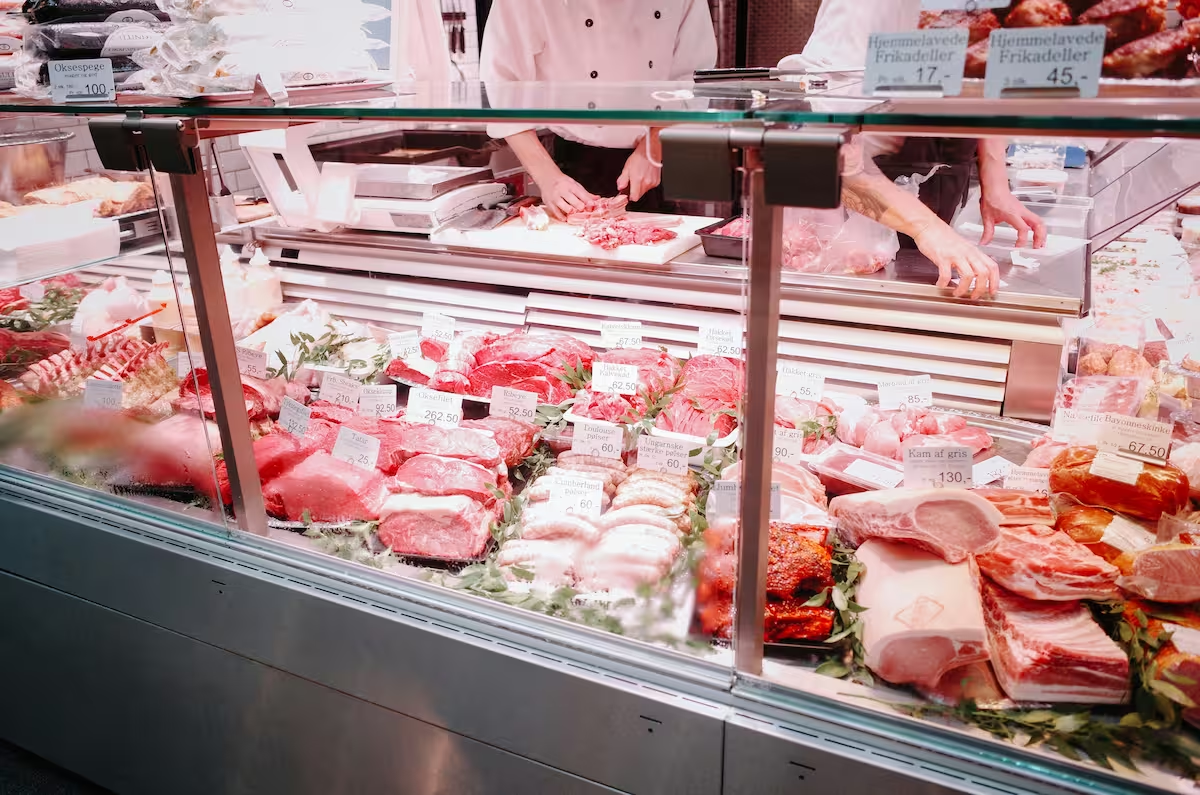
Twenty‑five years ago, in Santiago, we started working with burgers. Coming from traditional hospitality, we learned firsthand what makes a burger good or bad. The meat is the most decisive factor.
Our university was the Mercado de Abastos. Our first butcher, who before handling the knife had worked in kitchens abroad, didn't just sell to us; he taught us the most important lesson: "A good burger is born on the butcher's block, not on the griddle." Although he retired years ago, his legacy lives on: we now work with Carlos' butcher shop, a neighbour and close friend of our first supplier. They grind our meat keeping the exact same proportions we learned a quarter of a century ago. The principles remain intact in every burger we make.
This guide is not a theoretical manual. It is the wisdom he passed on to us and that, to this day, we still follow to the letter. If you want to learn more about how we put these principles into practice, we invite you to read "The Perfect Burger: The Balance Between Flavour and Health".
IN THIS GUIDE YOU WILL LEARN
- The three specific cuts we use and why each one is essential.
- The exact proportion (and the reason) that makes a burger juicy without being heavy.
- How to ask your butcher exactly what you need, with the right keywords.
THE FIRST LESSON: THERE IS NO SUCH THING AS "GROUND BEEF"
Our butcher used to laugh when someone simply asked for "ground beef for burgers". To him, it was like asking for "paint" for a painting without specifying the colour.
"You have to ask for the cuts by their name," he would say. "The secret isn't in the quantity, but in the blend. In the exact proportions."
The Round (or Beef Round)
It's the muscle from the leg. He recommended it as the base (60‑70% of the blend). "It's lean, has a firm but fine texture, and is juicy. It tastes like real meat, without excess."
The Chuck (or Shoulder)
It comes from the neck and shoulder area. "This is the soul of flavour," he explained. "It has intramuscular fat, the kind you don't see but that melts and gives incredible depth." We use it at 30‑40%.
A Touch of Skirt (or Flank)
"This is the secret weapon," he confessed. "It's flavourful fat. Not just any fat. A 5‑10% of finely ground skirt will make your burger memorable, that 'melts' without being greasy."
That's the formula. That's all. Twenty‑five years later, it's still exactly the same.
It doesn't change. It doesn't fail. Twenty‑five years confirm it.
THE ART OF GRINDING: A DETAIL THAT MAKES THE DIFFERENCE
When we mention that our butcher "grinds the meat for us", it might seem like a minor detail. It isn't. It was something our mentor insisted on: "The quality of the grind is almost as important as the choice of cuts."
Most butchers grind once. It's quick and it works. But we ask him to grind twice. Why?
A More Compact and Homogeneous Meat
When you grind once, the meat fragments are still visibly irregular. There are larger and smaller pieces, and the fat fibres aren't distributed evenly. Grinding twice gives you a much finer, more consistent texture: the meat becomes almost a pâté. That means when you shape a burger, the fragments close and adhere to each other more easily, creating a denser, more compact patty.
Better Cohesion Without Needing Binders
A burger must have body. If the meat is too coarse (single grind), you have to press it hard so it doesn't fall apart on the griddle. That's a mistake: you compress the cells, squeeze out the juices, and end up with a dry, tough burger. With a double grind, the meat already has that natural cohesion. It holds together without needing to be pressed, and therefore, heat doesn't force out the juices. The burger stays tender inside, even if you cook it to your preferred doneness.
Better Contact on the Griddle
A finer texture means more points of contact with the griddle. That translates into a better crust, crispier and more flavourful. It's the difference between a burger that looks hastily cooked and one that shows that characteristic sear of a good burger.
Our butcher used to say: "If you're not going to grind twice, don't bother choosing the cuts. You'll have wasted the advantage." It wasn't an exaggeration. In our bar, double grinding is non‑negotiable. It's part of the process that started on the butcher's block a quarter of a century ago, and it remains so.
THE DIFFERENCE BETWEEN GRINDING AND MASHING
Here comes an important technical detail: there's a huge difference between grinding meat correctly and mashing it. When meat is mashed (what happens with manual or low‑power grinders), the fibres are compressed and torn. That darkens the meat and makes it lose its natural juices in the process. You'll see that colour change: the meat turns darker, almost grey, and loses that essential juiciness.
An industrial grinder with power and blades specifically designed for this purpose works completely differently. The blades rotate at high speed and cut the fibres cleanly without compressing them. The meat remains intact in its structure, without darkening, without losing juices. That's what happens when a butcher shop has the right tools for this job. It's not just that they grind twice; it's that they do it with the correct equipment, which preserves the integrity and quality of the meat in a way that is practically impossible to replicate in any other context.
THE LESSON THEY DON'T TEACH YOU IN SCHOOL
When I studied hospitality, burgers were seen as a destination for leftover cuts. Our butcher completely changed that mindset for us.
"Obviously, it's not rib‑eye steak," he clarified. "For that you order rib‑eye. These are beef cuts that, while not prime, are not 'scraps'. They are cuts with a specific function. A good burger is meat with identity, not a catch‑all drawer."
School talked about the 70/30 lean‑to‑fat ratio, but in an abstract way. He made us understand what that 30% really meant: not any fat, but the flavourful fat from chuck and skirt. That marked the difference between making burgers and making good burgers.
HOW TO TALK TO YOUR BUTCHER (THE ADVICE THAT LASTS)
This is the most valuable gift we can pass on to you. You don't need to come to our supplier. Walk to your local market, look for the traditional butcher shop and say:
"Hello, I want to make burgers. Could you grind me a piece of round and a piece of chuck or shoulder? And if you have a little skirt, that would be great."
You'll see the difference immediately. You'll be buying meat with identity, not an anonymous product.
In a supermarket, ground beef usually comes from a blend of pieces without specific identity. In a specialised butcher shop, you can ask for the exact cuts you need. The difference in quality in the final result is noticeable. A butcher who understands which cut goes for which use is an important asset if you want to make quality burgers.
CONCLUSION: WHAT REALLY MATTERS
Making a good burger isn't about buying the most expensive meat. It's about understanding what you're buying, knowing why a blend works, and respecting the process. The cuts have a name and a specific function; they are not generic.
If you apply these principles—the right cuts, the exact proportions, the proper grind—you'll get a noticeably better result than if you go at it randomly. It's transferable knowledge. It's not magic nor does it depend on who does it, but on understanding the what and the why.
This knowledge comes from years of direct work with professional butchers who understand their craft. To all the butchers who pass on their know‑how and maintain the standard: this is your recognition. Without you, a good burger would be impossible.
— Antonio and Susana