What Oil Do You Fry Your Potatoes In? An Honest Answer from Our Kitchen
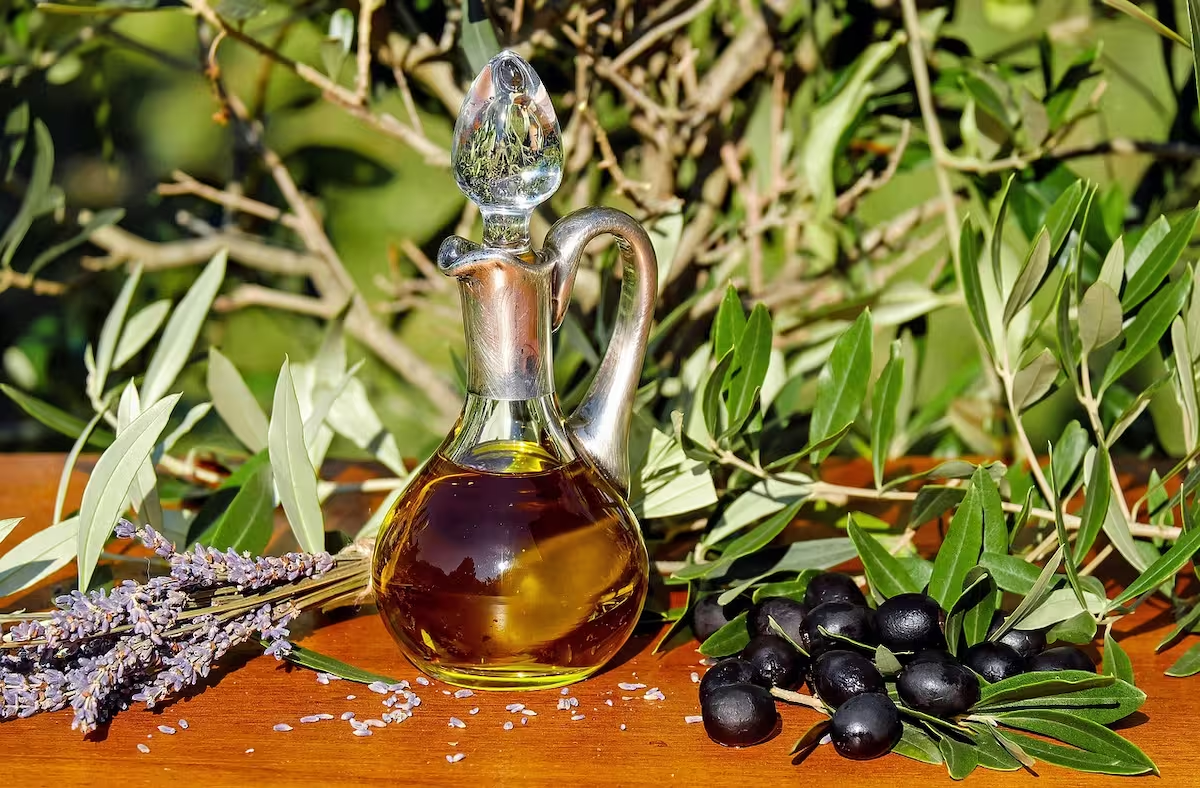
Our customers often ask us: "What kind of oil do you use for the fries?" or "Is that Extra Virgin on the salad?" I actually love it when they ask. Behind those questions is a genuine curiosity about what's on their plate.
That's why today I want to take a moment to share—not a nutritional lecture—but the honest "why" behind our choices. To make sense of it all, let's start with the basics. Choosing a fat or an oil depends entirely on its purpose: is it a vehicle for flavor? A way to get that perfect crunch? A fruity finishing touch for a salad? Or something to spread on warm bread? Each choice makes a world of difference, and ours is a balance between respecting the product and the fast-paced reality of a working kitchen.
To explain, I'll divide them into two groups, just as I was taught in culinary school: fats (solids) and oils (liquids).
1. The Tradition of Fats: From Lard to the Back of Our Memory
My starting point is a memory. As a young girl in the 70s and 80s, growing up in a rural village in Galicia, lard was the absolute queen of the kitchen. I fondly remember that 10-liter pot of white fat sitting by the wood-fired stove. It was used for everything: frying potatoes, sautéing, confit. There was no other fat in the house. Every dish had that subtle, characteristic savory depth that—for better or worse—was the house signature.
Fortunately, today we have an immense variety of options. In our kitchen, solid fats are almost symbolic. We might use a bit of butter for baking or our salted butter and mustard spread for sandwiches (it's delicious). As for lard... I can't remember the last time I used it. And while we rarely use margarine or vegetable shortenings, I admit that in a pinch, their versatility at room temperature can be a lifesaver.
2. Understanding the Bottle: The Secret is in the Label
Nowadays, almost everything we do over the flames happens in the liquid realm: oils. This is where a daily choice really impacts the final result.
As a chef, I believe the key to choosing well is knowing the basics and then—when you're at the store—taking a second to read the label (and the price tag). That's the formula for a dish that is as tasty as it is mindful.
First, not all oils are created equal. Some are obtained through cold-pressing, like Extra Virgin Olive Oil (EVOO); a mechanical process at controlled temperatures that keeps its nutrients and its soul intact. Others require heat or refining to become more neutral and stable, like sunflower oil or regular "refined" olive oil (which we shouldn't confuse with Extra Virgin).
3. The Reality at Señarís: Technical Honesty Under Fire
In our kitchen in Santiago, we apply the logic of culinary physics:
Sunflower Oil: Our Ally for Frying
This is our choice for high-heat frying and searing. It's noble under direct heat and has a neutral flavor that respects the original product 100%. It allows for that transformation we all crave—that perfect crunch—without breaking down too quickly.
Of course, there's a technical middle-ground, like high-oleic olive oil, which offers greater stability for frying. However, in the daily balance between technical excellence and the viability of a neighborhood business, we continue to opt for sunflower oil. It allows us to maintain the quality we seek without the ingredient cost dictating the final menu price. In the end, that's also a form of integrity.
⚠️ Important Note for Vegetarians and Dietary Restrictions
Let's be honest: oil is a vessel for flavor. In an ideal world, we'd fry every single item in its own dedicated vat. But in the reality of a kitchen with optimized space, there's an inevitable exchange of nuances. Potatoes might be fried in the same oil as chicken wings, and that blend is, in a way, what gives a neighborhood spot its unique "soul."
If you're vegetarian or have dietary restrictions, please let us know when you order your fries or any other fried item. We'll be more than happy to prepare them in first-use oil so you can enjoy your meal with total peace of mind.
Extra Virgin Olive Oil (EVOO): Our Liquid Treasure
This is our treasure—Spanish "liquid gold." It is the undisputed star of our raw dishes. What would a tomato salad be without a generous drizzle of EVOO? It would lose its heart.
It's also the ideal oil for the slow confit of the potatoes in our Spanish tortilla, where the heat is a gentle caress. However, in a busy spot like ours, theory sometimes clashes with a hungry crowd and fast service, forcing us to turn up the heat to avoid endless waits. The key is using it consciously: knowing that using it for extreme deep-frying is both a culinary waste and disrespectful to its biological integrity and delicate flavor notes.
4. A Global Perspective from Study and Experience
I speak from my experience in Spain and my years of study, where I discovered how to enhance flavors with walnut or almond oils. I know that in the US or Asia, canola, soybean, or coconut oils are staples, each with its own smoke point and flavor profile.
But the universal rule remains: cold-pressed oils obtained mechanically versus oils extracted through other means. The culinary principle is to use the former to enhance flavor and nourish properly, always respecting the nature of each fat and avoiding wasting its properties in the fire.
Final Thoughts from the Stove...
We use this knowledge about oil to apply the same philosophy we follow with every egg in our tortilla and every grain of salt we choose. They aren't isolated ingredients but parts of the same language: one that speaks of respect for well-being and the pursuit of satisfaction for those who sit at our table.
So, now you know the "how" and the "why." If you're craving some honest, crispy fries or that slow-cooked tortilla we love so much (if you give us the time and service allows!), you know where to find us.
I hope this helps you look at that bottle in your own kitchen with new eyes.
Still have questions about our ingredients? Stop by our place in Santiago and let's chat over a good meal. At Hamburguesería Señarís, transparency is part of the menu.
With love, from the kitchen at Hamburguesería Señarís.