Symbols and Meanings of the Camino de Santiago: Deciphering the Secret Language of Pilgrims
A journey through the symbols that have guided millions of pilgrims for centuries. Discover how the shell, the yellow arrow, and other symbols contain deep messages about the inner journey.
🎯 Why do symbols matter?
The Camino de Santiago is more than a physical route; it's a symbolic journey. Every symbol you encounter on the way has a meaning that transcends its practical function. These symbols form a secret language that pilgrims have shared for centuries, creating an invisible connection between generations of walkers.
From our burger bar in Santiago, we've seen thousands of pilgrims arrive. Some come with the shell hanging from their backpack, others with a staff worn from use, all with stories written on their faces. But few know the deep meaning of the symbols that have guided them here. Today we want to share this ancestral knowledge with you.
 1. The scallop shell: the universal symbol
🐚 The scallop shell (Venerupis decussata)
It's the most recognized symbol of the Camino. Medieval pilgrims carried it as proof of having completed the journey, but its meaning goes much further.
Physical guide
The ridges of the shell converge at one point, symbolizing all paths leading to Santiago.
Protection
Pilgrims used it as a bowl for drinking and eating, but also as spiritual protection.
Transformation
Like the mollusk that grows inside, the pilgrim transforms during the journey.
📜 Historical origin
Legend has it that when the body of the Apostle James was transferred to Galicia, a nobleman's horse got scared and fell into the sea. Miraculously, both horse and rider emerged covered in scallop shells. Since then, the shell has been associated with divine protection during the journey.
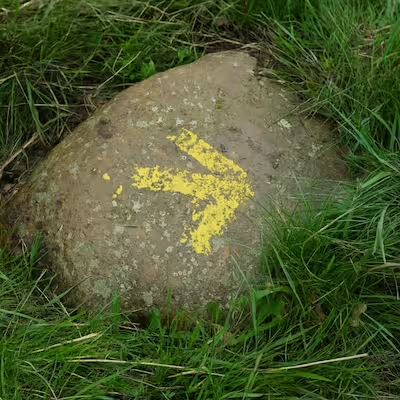 2. The yellow arrow: the language of the way
🟨 The yellow arrow
The simplest and most effective signage system in the world. Where there is no official signage, yellow arrows painted on stones, trees and posts guide pilgrims with surprising clarity.
Visibility
Yellow was chosen for its high visibility even in low light or rain conditions.
Community
Maintained by local volunteers, they represent the solidarity of communities with pilgrims.
Trust
They teach to trust simple signs and the kindness of those who painted them.
📜 Father Elías Valiña
This priest from O Cebreiro popularized the yellow arrows in the 1970s. With a can of yellow paint, he traveled the French Way marking the path. His work saved the Camino from oblivion and made it accessible to modern pilgrims.
 3. The pilgrim's staff: the third foot
🦯 The pilgrim's staff
More than just physical support, the staff is a symbol of faith and perseverance.
Physical support
Relieves pressure on knees and ankles, especially on steep descents.
Defense
Historically served to defend against wild animals and bandits.
Faith
Represents the faith that sustains the pilgrim on their spiritual journey.
🌳 The gourd: symbol of simplicity
The gourd (or pilgrim's flask) that hung from the staff was the container for water and food. It symbolizes self-sufficiency and connection with nature. In a world of plastic bottles, the gourd reminds us of the beauty of simplicity and sustainability.
Has this journey through Camino symbols interested you?
If this article has made you see the Camino with new eyes, we'd love to hear your perspective. When you arrive in Santiago, if you stop by our burger bar and mention this article, we'll treat you to a coffee or soft drink.
📸 The three main symbols
The shell
Universal symbol
The yellow arrow
Path guide
The pilgrim's staff
Third foot
When you arrive in Santiago, come visit us and share what these symbols meant to you on your Camino.
🍔 Señarís Burger Bar - Av. de Quiroga Palacios, 5 - Santiago de Compostela
☎️ Phone: 881 08 25 71
Visit us and share your interpretation of the symbolsFrequently Asked Questions about Camino Symbols
What does the scallop shell of the Camino de Santiago really mean?
The scallop shell (Venerupis decussata) is the universal symbol of the pilgrim. It represents not only the direction to Santiago (its ridges converge at one point, like the paths to the city), but also protection, spiritual guidance, and the transformation of the pilgrim.
What is the origin of the yellow arrows on the Camino?
The yellow arrows were popularized by Father Elías Valiña in the 1970s to mark the French Way. Yellow was chosen for its high visibility. Today they are the most recognized and reliable signage system on the Camino.
What does the pilgrim's staff symbolize?
The staff represents the pilgrim's third foot, but also symbolizes the faith that sustains them on their spiritual journey. Historically it served to defend against animals and bandits; today it represents physical and spiritual support.
Why do pilgrims carry a gourd?
The gourd (or pilgrim's flask) was the traditional container for carrying water and food. It symbolizes simplicity, self-sufficiency, and connection with nature. Today many pilgrims use modern bottles, but the gourd remains an iconic symbol.